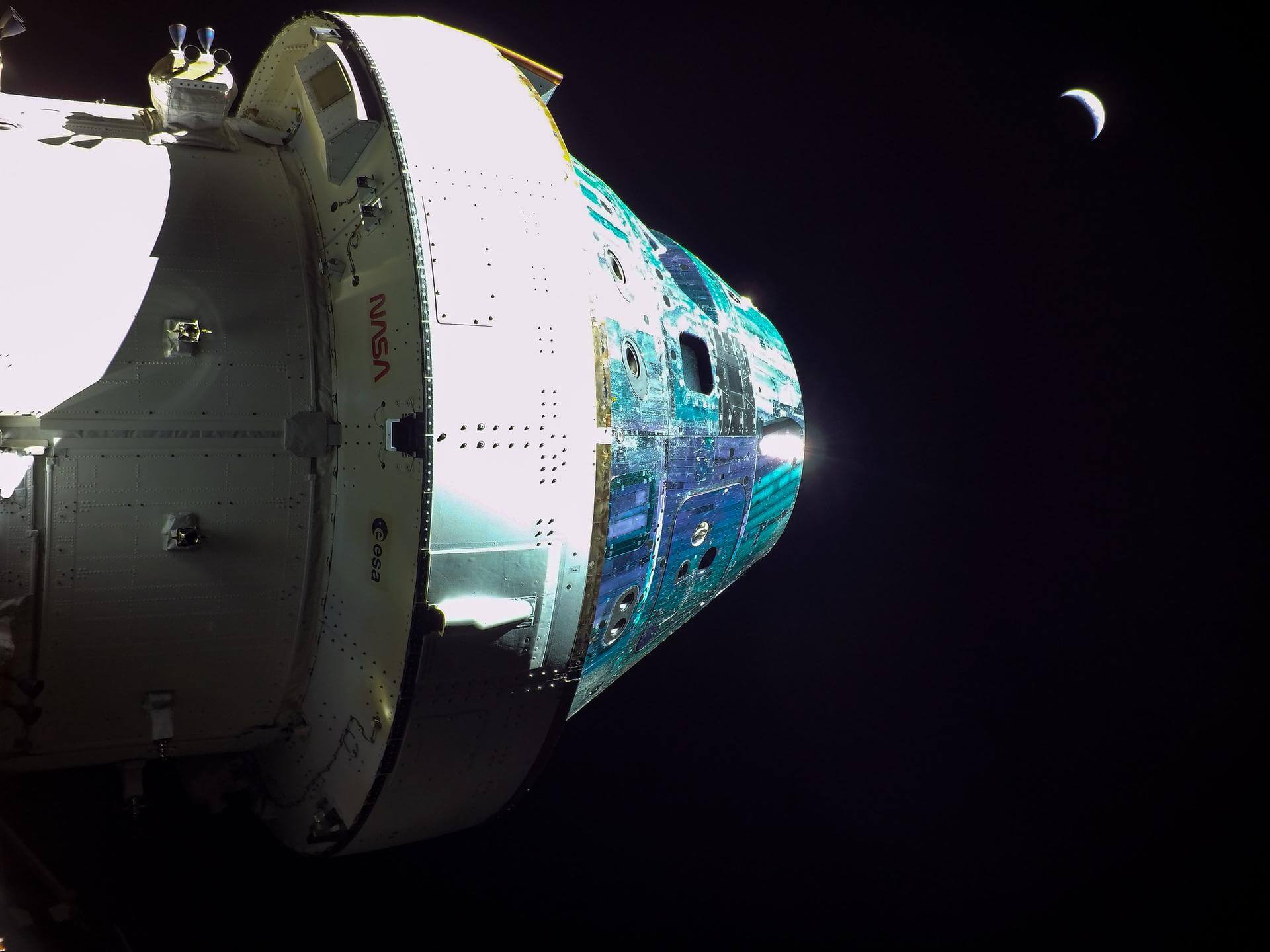
Orion
Active Human Rated Capsule Crew Capacity: 4 Payload Capacity: 100 kg Diameter: 5.03 m Height: 3.3 m()
Nov. 16, 2022
Lunar Missions.
Flight Life
21.1 days
Description
The Orion MPCV takes basic design elements from the Apollo Command Module that took astronauts to the moon, but its technology and capability are more advanced. It is designed to support long-duration deep space missions, with up to 21 days active crew time plus 6 months quiescent. During the quiescent period crew life support would be provided by another module such as a Deep Space Habitat. The spacecraft's life support, propulsion, thermal protection and avionics systems are designed to be upgradeable as new technologies become available. nn The MPCV spacecraft includes both crew and service modules, and a spacecraft adaptor. The MPCV's crew module is larger than Apollo's and can support more crew members for short or long-duration missions. The service module fuels and propels the spacecraft as well as storing oxygen and water for astronauts. The service module's structure is also being designed to provide locations to mount scientific experiments and cargo.
History
The Orion Multi-Purpose Crew Vehicle (Orion MPCV) is an American spacecraft intended to carry a crew of four astronauts to destinations at or beyond low Earth orbit (LEO). Currently under development by NASA for launch on the Space Launch System, Orion is intended to facilitate human exploration of asteroids and of Mars, as well as to provide a means of delivering or retrieving crew or supplies from the ISS if needed.
Starship
Starlink Group 31-1 (Starship Flight 14)
Orbital Launch Pad 2 - SpaceX Starbase, TX, USA14th test flight of the two-stage Starship launch vehicle. 3rd flight of Starship V3 and the first Starship flight to deploy satellites (a group of S…
Falcon 9
USSF-385
Space Launch Complex 4E - Vandenberg SFB, CA, USAA classified mission for the United States Space Force. It is possibly a batch of classified LEO satellites based on SpaceX’s Starshield satellite bu…
Electron
Owlright, Owlright, Owlright (StriX Launch 13)
Rocket Lab Launch Complex 1B - Rocket Lab Launch Complex 1, Mahia Peninsula, New ZealandSynthetic aperture radar satellite for Japanese Earth imaging company Synspective.
Long March 6A
Yaogan 40 Group 04
Launch Complex 9A - Taiyuan Satellite Launch Center, People's Republic of China3 Chinese reconnaissance satellites of unknown purposes, officially reported as for "Electromagnetic environment probing".
Long March 8A
SatNet LEO Group 26
Commercial LC-1 - Wenchang Space Launch Site, People's Republic of ChinaA batch of 9 Low Earth Orbit communication satellites for the Chinese state owned SatNet constellation operated by the China Satellite Network Group.…
Kinetica 1
9 satellites
Launch Area 130 - Jiuquan Satellite Launch Center, People's Republic of ChinaShare-ride of 9 commercial Earth observation and technology demonstration satellites to SSO, details TBD.
Falcon 9
Starlink Group 15-27
Space Launch Complex 4E - Vandenberg SFB, CA, USAA batch of 27 satellites for the Starlink mega-constellation - SpaceX's project for space-based Internet communication system.
Long March 2D
PIESAT-2 13-16
Launch Complex 9 - Taiyuan Satellite Launch Center, People's Republic of China4 X-band synthetic-aperture radar Earth observation satellites for the Chinese Earth observation satellite company PIESAT.
Electron
Owl By The Dozen (StriX Launch 12)
Rocket Lab Launch Complex 1B - Rocket Lab Launch Complex 1, Mahia Peninsula, New ZealandSynthetic aperture radar satellite for Japanese Earth imaging company Synspective.
Soyuz 2.1b/Fregat-M
Glonass-K1 No. 20 (?)
43/3 (43L) - Plesetsk Cosmodrome, Russian FederationNote: Satellite serial number and Cosmos designation not confirmed. Glonass-K are the third generation of satellite design for GLONASS satellite n…