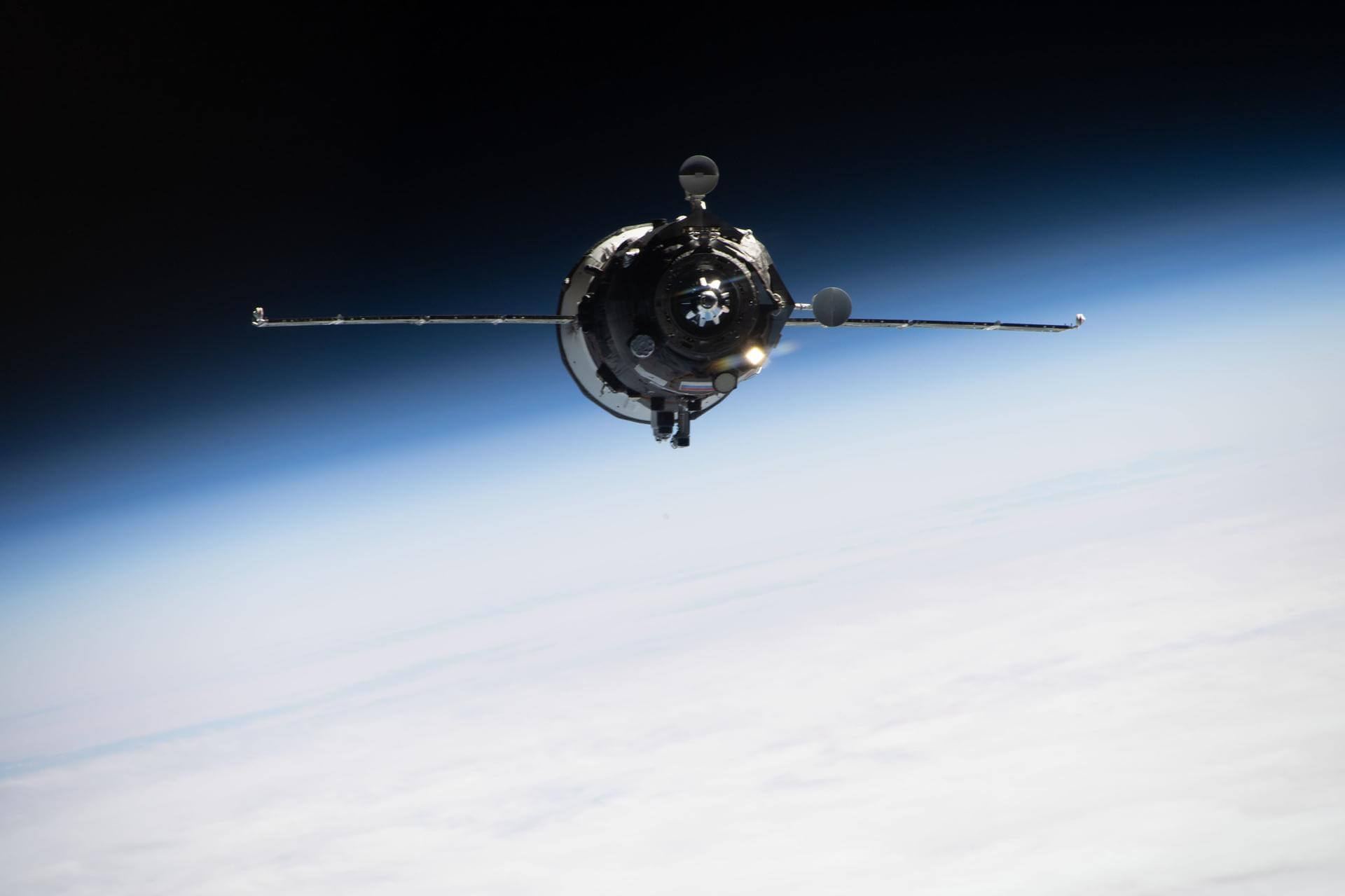
Progress-MS
Active Cargo Cargo Resupply Payload Capacity: 2400 kg Diameter: 2.72 m Height: 7.23 m()
Dec. 21, 2015
ISS Logistics, ISS Orbit Raising
Flight Life
6 Months docked to ISS
Description
Progress is derived from the manned Soyuz spacecraft and is launched on the same vehicle, a Soyuz rocket. The purpose of Progress is to deliver supplies needed to sustain human presence in orbit. Currently it is used as a re-supply spacecraft for the ISS.
History
Progress-MS is an improved variant which first launched on 21 December 2015. It has the following improvements: - New external compartment that enables it to deploy satellites. - Enhanced redundancy - Improved Micrometeoroid (MMOD) protection - Luch Russian relay satellites link capabilities - GNSS autonomous navigation - Real time relative navigation - New digital radio The Ukrainian Chezara Kvant-V on board radio system and antenna/feeder system has been replaced with a Unified Command Telemetry System (UCTS). - Replacement of the Kurs A with Kurs NA digital system.
Starship
Starlink Group 31-1 (Starship Flight 14)
Orbital Launch Pad 2 - SpaceX Starbase, TX, USA14th test flight of the two-stage Starship launch vehicle. 3rd flight of Starship V3 and the first Starship flight to deploy satellites (a group of S…
Falcon 9
USSF-385
Space Launch Complex 4E - Vandenberg SFB, CA, USAA classified mission for the United States Space Force. It is possibly a batch of classified LEO satellites based on SpaceX’s Starshield satellite bu…
Electron
Owlright, Owlright, Owlright (StriX Launch 13)
Rocket Lab Launch Complex 1B - Rocket Lab Launch Complex 1, Mahia Peninsula, New ZealandSynthetic aperture radar satellite for Japanese Earth imaging company Synspective.
Long March 6A
Yaogan 40 Group 04
Launch Complex 9A - Taiyuan Satellite Launch Center, People's Republic of China3 Chinese reconnaissance satellites of unknown purposes, officially reported as for "Electromagnetic environment probing".
Long March 8A
SatNet LEO Group 26
Commercial LC-1 - Wenchang Space Launch Site, People's Republic of ChinaA batch of 9 Low Earth Orbit communication satellites for the Chinese state owned SatNet constellation operated by the China Satellite Network Group.…
Kinetica 1
9 satellites
Launch Area 130 - Jiuquan Satellite Launch Center, People's Republic of ChinaShare-ride of 9 commercial Earth observation and technology demonstration satellites to SSO, details TBD.
Falcon 9
Starlink Group 15-27
Space Launch Complex 4E - Vandenberg SFB, CA, USAA batch of 27 satellites for the Starlink mega-constellation - SpaceX's project for space-based Internet communication system.
Long March 2D
PIESAT-2 13-16
Launch Complex 9 - Taiyuan Satellite Launch Center, People's Republic of China4 X-band synthetic-aperture radar Earth observation satellites for the Chinese Earth observation satellite company PIESAT.
Electron
Owl By The Dozen (StriX Launch 12)
Rocket Lab Launch Complex 1B - Rocket Lab Launch Complex 1, Mahia Peninsula, New ZealandSynthetic aperture radar satellite for Japanese Earth imaging company Synspective.
Soyuz 2.1b/Fregat-M
Glonass-K1 No. 20 (?)
43/3 (43L) - Plesetsk Cosmodrome, Russian FederationNote: Satellite serial number and Cosmos designation not confirmed. Glonass-K are the third generation of satellite design for GLONASS satellite n…