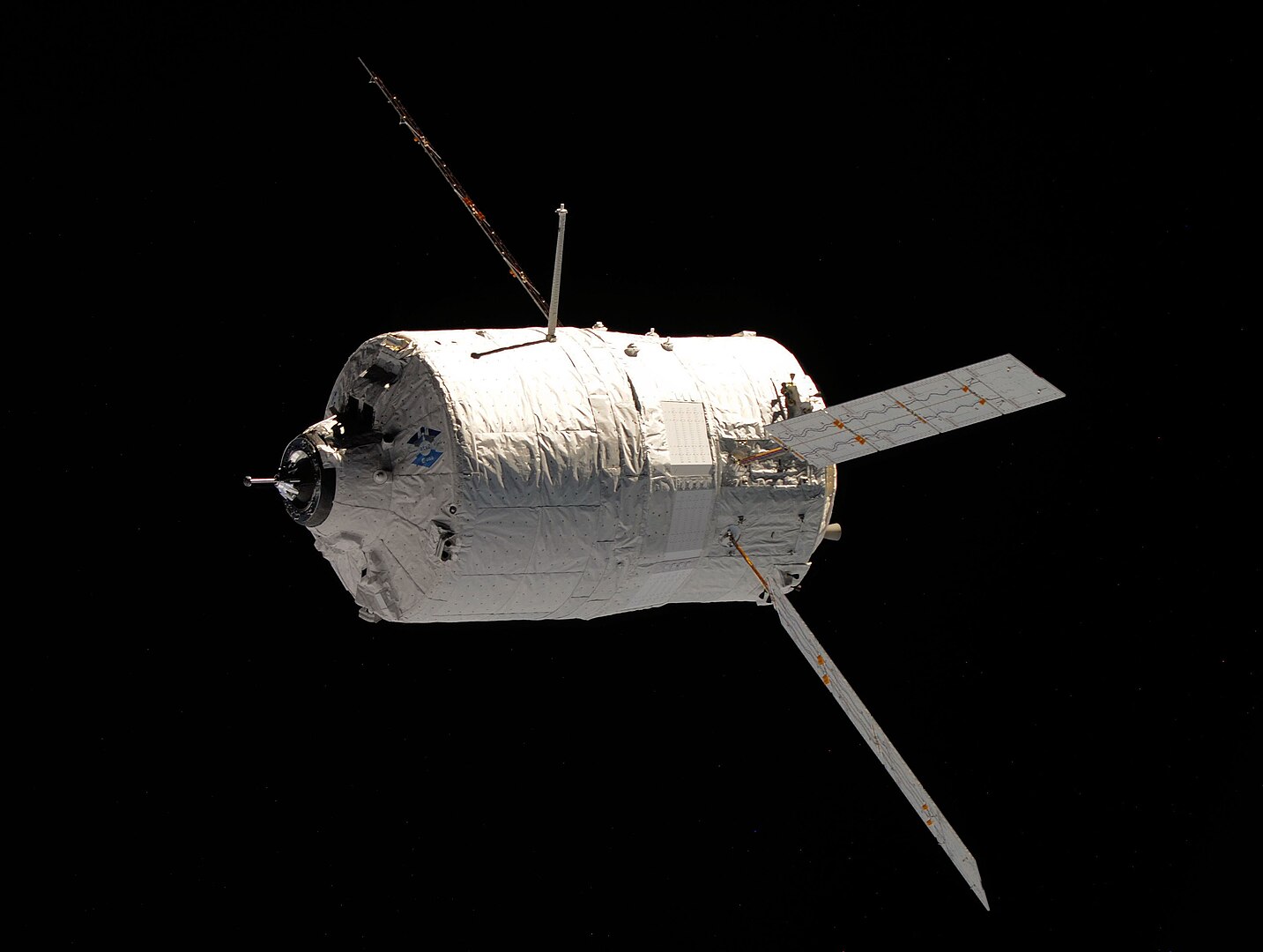
Automated Transfer Vehicle (ATV)
In-active Cargo Cargo Resupply Payload Capacity: 7667 kg Diameter: 4.5 m Height: 10.3 m()
March 9, 2008
Cargo Earth Orbit Logistics
Flight Life
Six months when docked
Description
In terms of its role, the ATV was designed to complement the smaller Russian Progress spacecraft, possessing three times its useful payload capacity. Similar to the Progress, it would carry both bulk liquids and relatively fragile freight, which would be stored within a cargo hold maintained at a pressurized shirt-sleeve environment in order that astronauts would be able to access payloads without the need to put on spacesuits. The pressurized cargo section of the ATV was based on the Italian-built Multi-Purpose Logistics Module (MPLM), which was a Shuttle-carried "space barge" that had been previously used for transporting equipment to and from the Station. Unlike the MPLM, the ATV used the same docking mechanism as employed upon the Progress. The ATV, like the Progress, also serves as a container for the station's waste. Each ATV weighs 20.7 tonnes at launch and has a cargo capacity of 8 tonnes.
History
During the 1990s, as the International Space Station program was taking place, it was collectively recognised by the 15 participating nations that, upon completion, the International Space Station (ISS), a crewed space station in Low Earth orbit (LEO), would require regular resupply missions in order to meet the needs of the onboard crew as well as to deliver apparatus to support the various scientific tests that would be performed on board. In October 1995, it was agreed that, amongst the various contributions to the ISS program that Europe would assume responsibility for under the vestiges of the European Space Agency (ESA), would be the Automated Transfer Vehicle, or ATV; this logistics-orientated spacecraft would perform the identified resupply missions to ISS.
Starship
Starlink Group 31-1 (Starship Flight 14)
Orbital Launch Pad 2 - SpaceX Starbase, TX, USA14th test flight of the two-stage Starship launch vehicle. 3rd flight of Starship V3 and the first Starship flight to deploy satellites (a group of S…
Falcon 9
USSF-385
Space Launch Complex 4E - Vandenberg SFB, CA, USAA classified mission for the United States Space Force. It is possibly a batch of classified LEO satellites based on SpaceX’s Starshield satellite bu…
Electron
Owlright, Owlright, Owlright (StriX Launch 13)
Rocket Lab Launch Complex 1B - Rocket Lab Launch Complex 1, Mahia Peninsula, New ZealandSynthetic aperture radar satellite for Japanese Earth imaging company Synspective.
Long March 6A
Yaogan 40 Group 04
Launch Complex 9A - Taiyuan Satellite Launch Center, People's Republic of China3 Chinese reconnaissance satellites of unknown purposes, officially reported as for "Electromagnetic environment probing".
Long March 8A
SatNet LEO Group 26
Commercial LC-1 - Wenchang Space Launch Site, People's Republic of ChinaA batch of 9 Low Earth Orbit communication satellites for the Chinese state owned SatNet constellation operated by the China Satellite Network Group.…
Kinetica 1
9 satellites
Launch Area 130 - Jiuquan Satellite Launch Center, People's Republic of ChinaShare-ride of 9 commercial Earth observation and technology demonstration satellites to SSO, details TBD.
Falcon 9
Starlink Group 15-27
Space Launch Complex 4E - Vandenberg SFB, CA, USAA batch of 27 satellites for the Starlink mega-constellation - SpaceX's project for space-based Internet communication system.
Long March 2D
PIESAT-2 13-16
Launch Complex 9 - Taiyuan Satellite Launch Center, People's Republic of China4 X-band synthetic-aperture radar Earth observation satellites for the Chinese Earth observation satellite company PIESAT.
Electron
Owl By The Dozen (StriX Launch 12)
Rocket Lab Launch Complex 1B - Rocket Lab Launch Complex 1, Mahia Peninsula, New ZealandSynthetic aperture radar satellite for Japanese Earth imaging company Synspective.
Soyuz 2.1b/Fregat-M
Glonass-K1 No. 20 (?)
43/3 (43L) - Plesetsk Cosmodrome, Russian FederationNote: Satellite serial number and Cosmos designation not confirmed. Glonass-K are the third generation of satellite design for GLONASS satellite n…