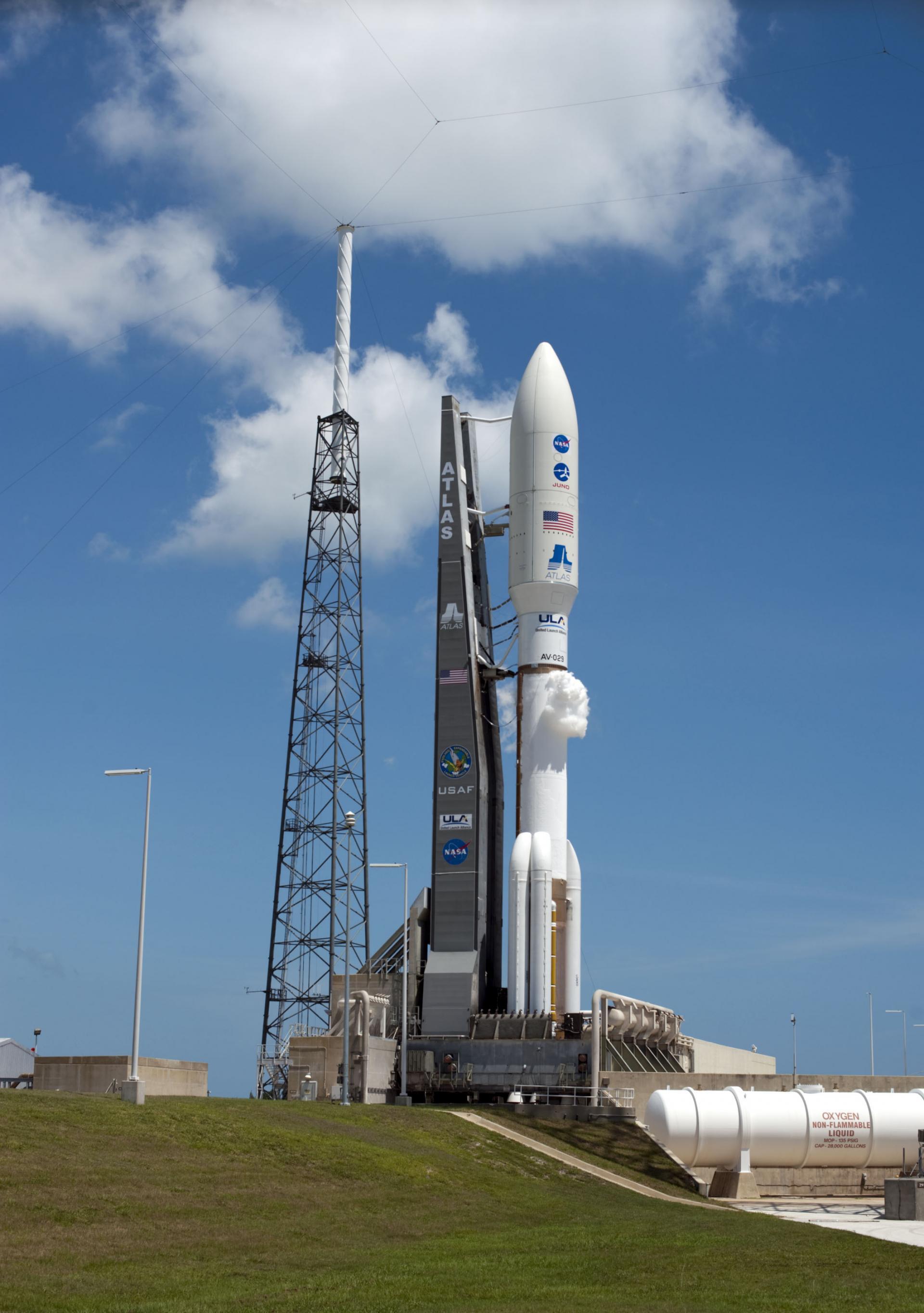
Atlas V 551
In-activeUnited Launch Alliance (ULA)
Jan. 19, 2006
Description
Atlas V is an expendable launch system in the Atlas rocket family. It was formerly operated by Lockheed Martin and is now operated by United Launch Alliance (ULA), a joint venture with Boeing. Each Atlas V rocket uses a Russian-built RD-180 engine burning kerosene and liquid oxygen to power its first stage and an American-built RL10 engine burning liquid hydrogen and liquid oxygen to power its Centaur upper stage. The RD-180 engines are provided by RD Amross, while Aerojet Rocketdyne provides both the RL10 engines and the strap-on boosters used in some configurations. The standard payload fairing sizes are 4 or 5 meters in diameter and of various lengths. Fairings sizes as large as 7.2 m in diameter and up to 32.3 m in length have been considered. The rocket is assembled in Decatur, Alabama and Harlingen, Texas.
Specifications
-
Minimum Stage
1 -
Max Stage
2 -
Length
59.7 m -
Diameter
3.8 m -
Fairing Diameter
5.4 m -
Launch Mass
573.0 T -
Thrust
12269.0 kN -
Apogee (Sub-Orbital)
40000.0 km
Family
-
Name
Atlas V 551 -
Family
― -
Variant
551 -
Alias
― -
Full Name
Atlas V 551
Payload Capacity
-
Launch Cost
$153000000 -
Low Earth Orbit
18850.0 kg -
Geostationary Transfer
Orbit
8890.0 kg -
Direct Geostationary
3850.0 kg -
Sun-Synchronous Capacity
―
United Launch Alliance
Commercial
CEO: Mark Peller
ULA 2006United Launch Alliance (ULA) is a joint venture of Lockheed Martin Space Systems and Boeing Defense, Space & Security. ULA was formed in December 2006 by combining the teams at these companies which provide spacecraft launch services to the government of the United States. ULA launches from both coasts of the US. They launch their Atlas V vehicle from LC-41 in Cape Canaveral and LC-3E at Vandeberg. Their Delta IV launches from LC-37 at Cape Canaveral and LC-6 at Vandenberg.
Atlas V 551 | Amazon Leo (LA-08)
United Launch Alliance | United States of AmericaCape Canaveral SFS, FL, USA
Status: Launch Successful
Mission:
Amazon Leo, formerly known as Project Kuiper, is a mega constellation of satellites in Low Earth Orbit that will offer broadband internet access, this constellation will be managed by Kuiper Systems LLC, a subsidiary of Amazon. This constellation is planned to be composed of 3,276 satellites. The satellites are projected to be placed in 98 orbital planes in three orbital layers, one at 590 km, 610 km and 630 km altitude. 29 satellites are carried on this launch.
Low Earth OrbitAtlas V 551 | Amazon Leo (LA-07)
United Launch Alliance | United States of AmericaCape Canaveral SFS, FL, USA
Status: Launch Successful
Mission:
Amazon Leo, formerly known as Project Kuiper, is a mega constellation of satellites in Low Earth Orbit that will offer broadband internet access, this constellation will be managed by Kuiper Systems LLC, a subsidiary of Amazon. This constellation is planned to be composed of 3,276 satellites. The satellites are projected to be placed in 98 orbital planes in three orbital layers, one at 590 km, 610 km and 630 km altitude. 29 satellites are carried on this launch.
Low Earth OrbitAtlas V 551 | Amazon Leo (LA-06)
United Launch Alliance | United States of AmericaCape Canaveral SFS, FL, USA
Status: Launch Successful
Mission:
Amazon Leo, formerly known as Project Kuiper, is a mega constellation of satellites in Low Earth Orbit that will offer broadband internet access, this constellation will be managed by Kuiper Systems LLC, a subsidiary of Amazon. This constellation is planned to be composed of 3,276 satellites. The satellites are projected to be placed in 98 orbital planes in three orbital layers, one at 590 km, 610 km and 630 km altitude. 29 satellites are carried on this launch.
Low Earth OrbitAtlas V 551 | Amazon Leo (LA-05)
United Launch Alliance | United States of AmericaCape Canaveral SFS, FL, USA
Status: Launch Successful
Mission:
Amazon Leo, formerly known as Project Kuiper, is a mega constellation of satellites in Low Earth Orbit that will offer broadband internet access, this constellation will be managed by Kuiper Systems LLC, a subsidiary of Amazon. This constellation is planned to be composed of 3,276 satellites. The satellites are projected to be placed in 98 orbital planes in three orbital layers, one at 590 km, 610 km and 630 km altitude. 29 satellites are carried on this launch.
Low Earth Orbit
Atlas V 551 | Amazon Leo (LA-04)
United Launch Alliance | United States of AmericaCape Canaveral SFS, FL, USA
Status: Launch Successful
Mission:
Amazon Leo, formerly known as Project Kuiper, is a mega constellation of satellites in Low Earth Orbit that will offer broadband internet access, this constellation will be managed by Kuiper Systems LLC, a subsidiary of Amazon. This constellation is planned to be composed of 3,276 satellites. The satellites are projected to be placed in 98 orbital planes in three orbital layers, one at 590 km, 610 km and 630 km altitude. 27 satellites are carried on this launch.
Low Earth OrbitAtlas V 551 | ViaSat-3 F2 (ViaSat-3 EMEA)
United Launch Alliance | United States of AmericaCape Canaveral SFS, FL, USA
Status: Launch Successful
Mission:
The ViaSat-3 is a series of three Ka-band satellites is expected to provide vastly superior capabilities in terms of service speed and flexibility for a satellite platform. Each ViaSat-3 class satellite is expected to deliver more than 1-Terabit per second of network capacity, and to leverage high levels of flexibility to dynamically direct capacity to where customers are located.
Geostationary Transfer OrbitStarship
Starlink Group 31-1 (Starship Flight 14)
Orbital Launch Pad 2 - SpaceX Starbase, TX, USA14th test flight of the two-stage Starship launch vehicle. 3rd flight of Starship V3 and the first Starship flight to deploy satellites (a group of S…
Falcon 9
USSF-385
Space Launch Complex 4E - Vandenberg SFB, CA, USAA classified mission for the United States Space Force. It is possibly a batch of classified LEO satellites based on SpaceX’s Starshield satellite bu…
Electron
Owlright, Owlright, Owlright (StriX Launch 13)
Rocket Lab Launch Complex 1B - Rocket Lab Launch Complex 1, Mahia Peninsula, New ZealandSynthetic aperture radar satellite for Japanese Earth imaging company Synspective.
Long March 6A
Yaogan 40 Group 04
Launch Complex 9A - Taiyuan Satellite Launch Center, People's Republic of China3 Chinese reconnaissance satellites of unknown purposes, officially reported as for "Electromagnetic environment probing".
Long March 8A
SatNet LEO Group 26
Commercial LC-1 - Wenchang Space Launch Site, People's Republic of ChinaA batch of 9 Low Earth Orbit communication satellites for the Chinese state owned SatNet constellation operated by the China Satellite Network Group.…