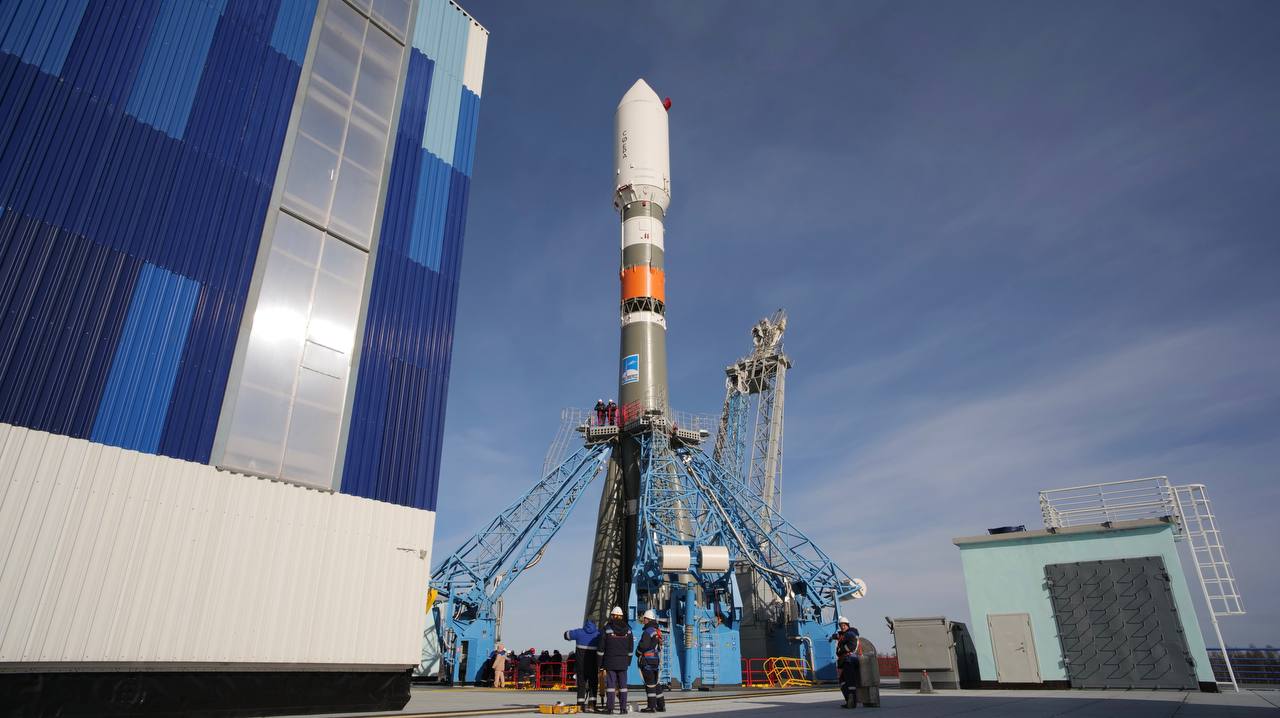
Soyuz 2.1b
ActiveProgress Rocket Space Center (PRSC)
July 26, 2008
Description
Soyuz-2 is the 21st-century version of the Russian Soyuz rocket. In its basic form, it is a three-stage carrier rocket for placing payloads into low Earth orbit. The 2.1b version adds an upgraded engine (RD-0124) with improved performance to the second stage.
Specifications
-
Minimum Stage
2 -
Max Stage
3 -
Length
46.3 m -
Diameter
2.95 m -
Fairing Diameter
― -
Launch Mass
312.0 T -
Thrust
―
Family
-
Name
Soyuz 2.1b -
Family
― -
Variant
― -
Alias
― -
Full Name
Soyuz 2.1b
Payload Capacity
-
Launch Cost
$80000000 -
Low Earth Orbit
8200.0 kg -
Geostationary Transfer
Orbit
3250.0 kg -
Direct Geostationary
― -
Sun-Synchronous Capacity
4900.0 kg
Progress Rocket Space Center
Commercial
CEO: Dmitry Baranov
PRSC 1996Progress Rocket Space Centre, formerly known as TsSKB-Progress, is a space science and aerospace research company which is known for manufacturing launch vehicles and satellites. Most notably, Progress Rocket Space Centre is the manufacturer of Soyuz launch vehicles.
Soyuz 2.1b | 16 x Rassvet-3
Progress Rocket Space Center | RussiaPlesetsk Cosmodrome, Russian Federation
March 23, 2026, 5:24 p.m.
Soyuz 2.1b | Bion-M No. 2
Progress Rocket Space Center | RussiaBaikonur Cosmodrome, Republic of Kazakhstan
Aug. 20, 2025, 5:13 p.m.
Status: Launch Successful
Mission:
Bion-M is the next generation of Russian biological research satellites. While retaining the Vostok/Zenit-derived reentry module of the earlier Bion, the propulsion module has been replace by a Yantar type module, which provides maneuvering capabilities and longer mission support. The mission duration has been increased to up to 6 months by using solar cells for energy generation. The weight of scientific equipment has been increased by 100 kilograms.
Low Earth OrbitFalcon 9
Starlink Group 17-35
Space Launch Complex 4E - Vandenberg SFB, CA, USAA batch of 25 satellites for the Starlink mega-constellation - SpaceX's project for space-based Internet communication system.
Falcon 9
Starlink Group 10-58
Space Launch Complex 40 - Cape Canaveral SFS, FL, USAA batch of 29 satellites for the Starlink mega-constellation - SpaceX's project for space-based Internet communication system.
Soyuz-5
Demo Flight
45/1 - Baikonur Cosmodrome, Republic of KazakhstanDemonstration Flight for Russia's new Soyuz-5 launch vehicle, with a mass simulator on board. Details TBD.
Space Launch System (SLS)
Artemis II
Launch Complex 39B - Kennedy Space Center, FL, USAArtemis II is the first crewed mission as part of the Artemis program. Artemis II will send a crew of 4 - 3 Americans and 1 Canadian around the moon …
Soyuz 2.1a/Fregat-M
Meridian-M No.21L
43/3 (43L) - Plesetsk Cosmodrome, Russian FederationNote: Payload identity uncertain. Meridian is a series of communications satellite for military and civilian use.