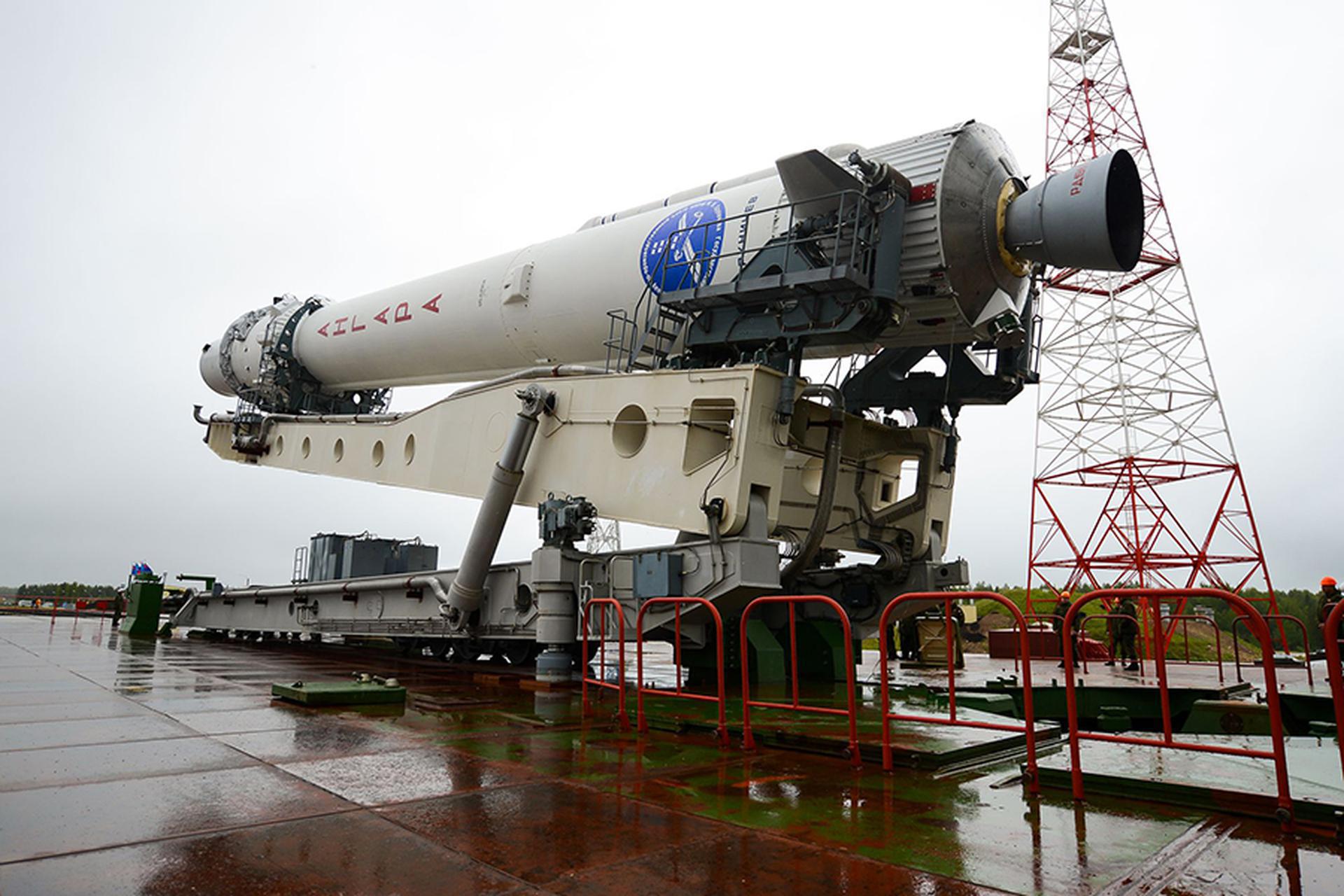
Angara 1.2
ActiveKhrunichev State Research and Production Space Center (KhSC)
July 9, 2014
Description
The Angara 1.2 is the base launcher for the Angara launch family that uses a modular approach to create multiple launch vehicle configurations for various mission requirements. The Angara 1.2 consists of a standard Universal Rocket Module for the core stage and either a modified Block I Upper Stage or a Briz-KM upper stage.
Specifications
-
Stages
2 -
Length
41.5 m -
Diameter
2.9 m -
Fairing Diameter
2.9 m -
Launch Mass
171.0 T -
Thrust
1920.0 kN
Family
-
Name
Angara 1.2 -
Family
― -
Variant
1.2 -
Alias
― -
Full Name
Angara 1.2
Payload Capacity
-
Launch Cost
$31000000 -
Low Earth Orbit
3700.0 kg -
Geostationary Transfer
Orbit
― -
Direct Geostationary
― -
Sun-Synchronous Capacity
2400.0 kg
Khrunichev State Research and Production Space Center
Government
Director: Andrey Vladimirovich Kalinovskiy
KhSC 1916Khrunichev State Research and Production Space Center is a Moscow-based producer of spacecraft and space-launch systems, including the Proton and Rokot rockets and is currently developing the Angara rocket family. The Proton launch vehicle launches from Baikonur and Rokot launches from Baikonur and Plesetsk. Angara will launch from Plesetsk and Vostochny.
Angara 1.2 | Kosmos 2615-2618
Khrunichev State Research and Production Space Center | RussiaPlesetsk Cosmodrome, Russian Federation
Angara 1.2 | 3 x Rodnik (Kosmos 2597, 2598, 2599)
Khrunichev State Research and Production Space Center | RussiaPlesetsk Cosmodrome, Russian Federation
Status: Launch Successful
Mission:
Note: Payload identity and Cosmos series numbering not confirmed. The Strela (Russian: Стрела) are Soviet, then Russian, military space telecommunication satellites, in use since 1964. These satellites operate as mailboxes ("store-and-forward"): they remember the received messages and then resend them after the scheduled time, or by a command from the Earth. They can serve for up to five years. The satellites are used for transmission of encrypted messages and images. The operational constellation consists of 12 satellites in two orbital planes, spaced 90° apart. The spacecraft had a cylindrical body with a gravity-gradient boom, which was extended on-orbit to provide passive attitude stabilization. On-board storage was 12 Mbits of data, with a transmission rate of 2.4 kbit/s. The first three satellites were launched in 1964 by a Cosmos launcher. After one year of service, new and improved satellites were launched, called Strela-2. In 1970, these satellites were modernized, and became the Strela-1M and Strela-2M satellites. From 1985, these satellites will be gradually replaced by Strela-3, and then by Strela-3M from 2005. A civilian version of these satellites was created, called Goniets. Initially they were launched in groups of six on Tsyklon; when the launcher was retired, they were only launched by two on Cosmos, before Rokot was put into service and allowed the sending of triplets of Strela satellites.
Low Earth OrbitStarship
Starlink Group 31-1 (Starship Flight 14)
Orbital Launch Pad 2 - SpaceX Starbase, TX, USA14th test flight of the two-stage Starship launch vehicle. 3rd flight of Starship V3 and the first Starship flight to deploy satellites (a group of S…
Falcon 9
USSF-385
Space Launch Complex 4E - Vandenberg SFB, CA, USAA classified mission for the United States Space Force. It is possibly a batch of classified LEO satellites based on SpaceX’s Starshield satellite bu…
Electron
Owlright, Owlright, Owlright (StriX Launch 13)
Rocket Lab Launch Complex 1B - Rocket Lab Launch Complex 1, Mahia Peninsula, New ZealandSynthetic aperture radar satellite for Japanese Earth imaging company Synspective.
Long March 6A
Yaogan 40 Group 04
Launch Complex 9A - Taiyuan Satellite Launch Center, People's Republic of China3 Chinese reconnaissance satellites of unknown purposes, officially reported as for "Electromagnetic environment probing".
Long March 8A
SatNet LEO Group 26
Commercial LC-1 - Wenchang Space Launch Site, People's Republic of ChinaA batch of 9 Low Earth Orbit communication satellites for the Chinese state owned SatNet constellation operated by the China Satellite Network Group.…