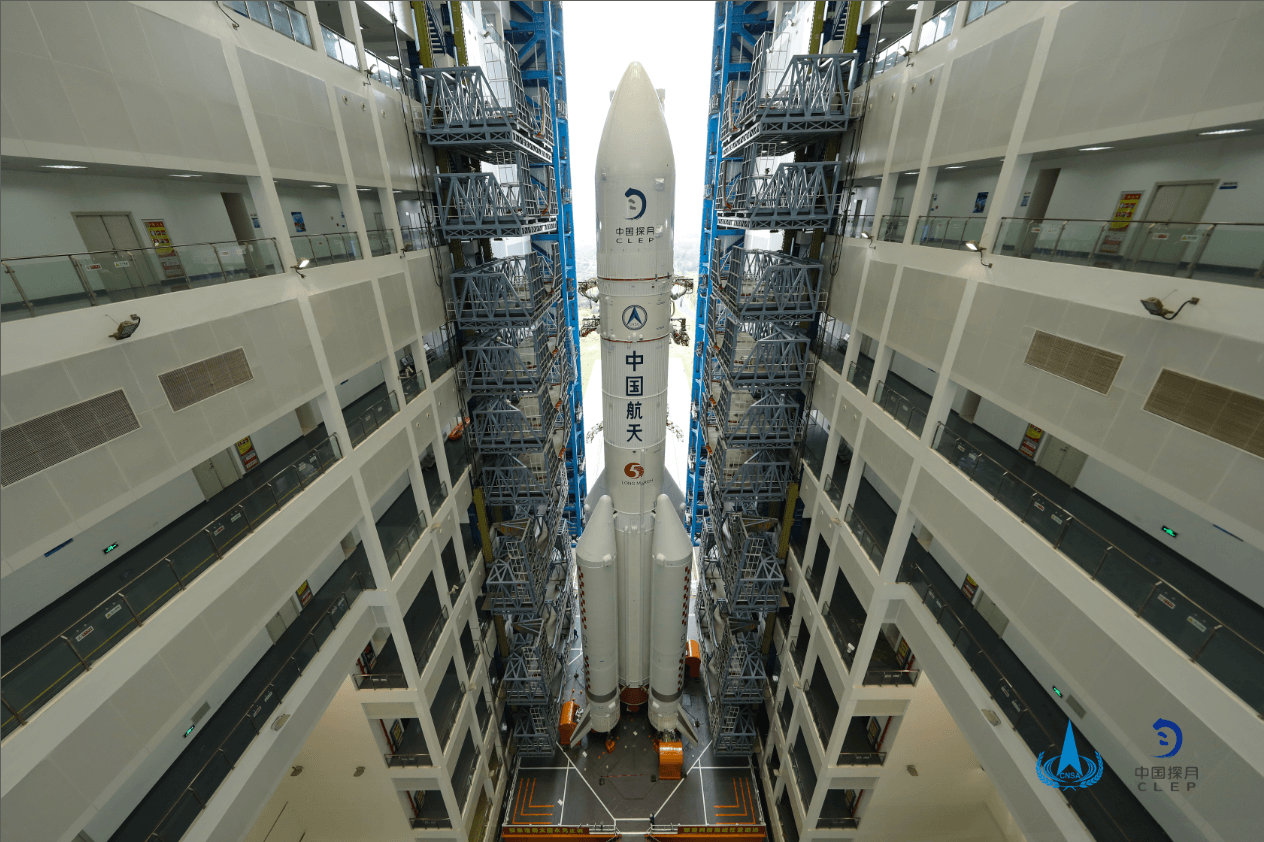
Long March 5
ActiveChina Aerospace Science and Technology Corporation (CASC)
Nov. 3, 2016
Description
Long March 5 is a Chinese heavy lift launch system developed by China Academy of Launch Vehicle Technology (CALT). CZ-5 is the first Chinese vehicle designed from the ground up to focus on non-hypergolic liquid rocket propellants. Currently, two CZ-5 vehicle configurations are planned, with maximum payload capacities of ~25,000 kilograms (55,000 lb) to LEO and ~14,000 kilograms (31,000 lb) to GTO. The Long March 5 roughly matches the capabilities of American EELV heavy-class vehicles such as the Delta IV Heavy.
Specifications
-
Stages
2 -
Length
57.0 m -
Diameter
5.0 m -
Fairing Diameter
― -
Launch Mass
867.0 T -
Thrust
10600.0 kN
Family
-
Name
Long March 5 -
Family
― -
Variant
― -
Alias
― -
Full Name
Long March 5
Payload Capacity
-
Launch Cost
― -
Low Earth Orbit
25000.0 kg -
Geostationary Transfer
Orbit
14000.0 kg -
Direct Geostationary
― -
Sun-Synchronous Capacity
―
China Aerospace Science and Technology Corporation
Government
Chairman & President: Lei Fanpei
CASC 1999The China Aerospace Science and Technology Corporation (CASC) is the main contractor for the Chinese space program. It is state-owned and has a number of subordinate entities which design, develop and manufacture a range of spacecraft, launch vehicles, strategic and tactical missile systems, and ground equipment. It was officially established in July 1999 as part of a Chinese government reform drive, having previously been one part of the former China Aerospace Corporation. Various incarnations of the program date back to 1956.
Upcoming Spaceflights
Long March 5 | Chang'e 7
China Aerospace Science and Technology Corporation | ChinaWenchang Space Launch Site, People's Republic of China
TBD December, 2026
Status: To Be Determined
Mission:
Chang'e 7/CE-7 is scheduled to launch in 2026, including an orbiter, a lander, a mini-hopping probe, and a rover. The mission will land in the South Pole regions of the Moon to study lunar surface environment around the South Pole, especially in looking for water ice in lunar soil.
Lunar OrbitLong March 5 | TJSW-23
China Aerospace Science and Technology Corporation | ChinaWenchang Space Launch Site, People's Republic of China
Dec. 20, 2025, 12:30 p.m.
Long March 5 | TJSW-20
China Aerospace Science and Technology Corporation | ChinaWenchang Space Launch Site, People's Republic of China
Oct. 23, 2025, 2:30 p.m.
Falcon 9
Starlink Group 17-35
Space Launch Complex 4E - Vandenberg SFB, CA, USAA batch of 25 satellites for the Starlink mega-constellation - SpaceX's project for space-based Internet communication system.
Falcon 9
Starlink Group 10-58
Space Launch Complex 40 - Cape Canaveral SFS, FL, USAA batch of 29 satellites for the Starlink mega-constellation - SpaceX's project for space-based Internet communication system.
Soyuz-5
Demo Flight
45/1 - Baikonur Cosmodrome, Republic of KazakhstanDemonstration Flight for Russia's new Soyuz-5 launch vehicle, with a mass simulator on board. Details TBD.
Space Launch System (SLS)
Artemis II
Launch Complex 39B - Kennedy Space Center, FL, USAArtemis II is the first crewed mission as part of the Artemis program. Artemis II will send a crew of 4 - 3 Americans and 1 Canadian around the moon …
Soyuz 2.1a/Fregat-M
Meridian-M No.21L
43/3 (43L) - Plesetsk Cosmodrome, Russian FederationNote: Payload identity uncertain. Meridian is a series of communications satellite for military and civilian use.