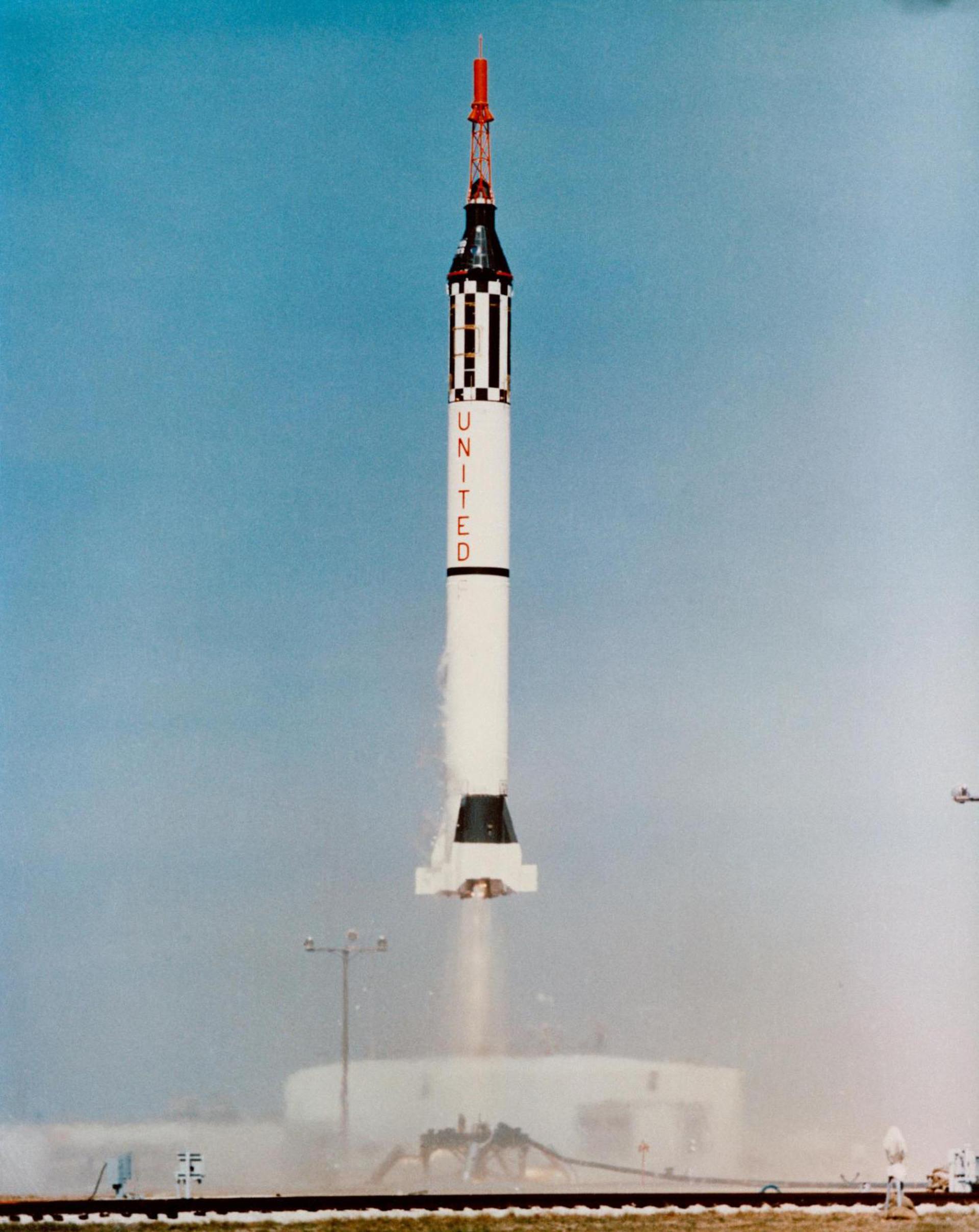
Redstone
In-activeChrysler (CHR)
Nov. 21, 1960
Description
The Mercury-Redstone Launch Vehicle, designed for NASA's Project Mercury, was the first American manned space booster. It was used for six sub-orbital Mercury flights from 1960–61; culminating with the launch of the first, and 11 weeks later, the second American (and the second and third humans) in space. The four subsequent Mercury human spaceflights used the more powerful Atlas booster to enter low Earth orbit. A member of the Redstone rocket family, it was derived from the U.S. Army's Redstone ballistic missile and the first stage of the related Jupiter-C launch vehicle; but to human-rate it, the structure and systems were modified to improve safety and reliability.
Specifications
-
Stages
1 -
Length
25.41 m -
Diameter
1.78 m -
Fairing Diameter
1.78 m -
Launch Mass
30.0 T -
Thrust
― -
Apogee (Sub-Orbital)
260.0 km
Family
-
Name
Redstone -
Family
― -
Variant
MRLV -
Alias
― -
Full Name
Redstone MRLV
Payload Capacity
-
Launch Cost
― -
Low Earth Orbit
― -
Geostationary Transfer
Orbit
― -
Direct Geostationary
― -
Sun-Synchronous Capacity
―
Chrysler
Commercial
None
CHR 1950In July 1959, NASA chose the Redstone missile as the basis for the Mercury-Redstone Launch Vehicle to be used for suborbital test flights of the Project Mercury spacecraft. Three unmanned MRLV launch attempts were made between November 1960 and March 1961, two of which were successful. The MRLV successfully launched the chimpanzee Ham, and astronauts Alan Shepard and Gus Grissom on three suborbital flights in January, May and July 1961, respectively.
Flight Record
No spaceflights found for .
Starship
Starlink Group 31-1 (Starship Flight 14)
Orbital Launch Pad 2 - SpaceX Starbase, TX, USA14th test flight of the two-stage Starship launch vehicle. 3rd flight of Starship V3 and the first Starship flight to deploy satellites (a group of S…
Falcon 9
USSF-385
Space Launch Complex 4E - Vandenberg SFB, CA, USAA classified mission for the United States Space Force. It is possibly a batch of classified LEO satellites based on SpaceX’s Starshield satellite bu…
Electron
Owlright, Owlright, Owlright (StriX Launch 13)
Rocket Lab Launch Complex 1B - Rocket Lab Launch Complex 1, Mahia Peninsula, New ZealandSynthetic aperture radar satellite for Japanese Earth imaging company Synspective.
Long March 6A
Yaogan 40 Group 04
Launch Complex 9A - Taiyuan Satellite Launch Center, People's Republic of China3 Chinese reconnaissance satellites of unknown purposes, officially reported as for "Electromagnetic environment probing".
Long March 8A
SatNet LEO Group 26
Commercial LC-1 - Wenchang Space Launch Site, People's Republic of ChinaA batch of 9 Low Earth Orbit communication satellites for the Chinese state owned SatNet constellation operated by the China Satellite Network Group.…