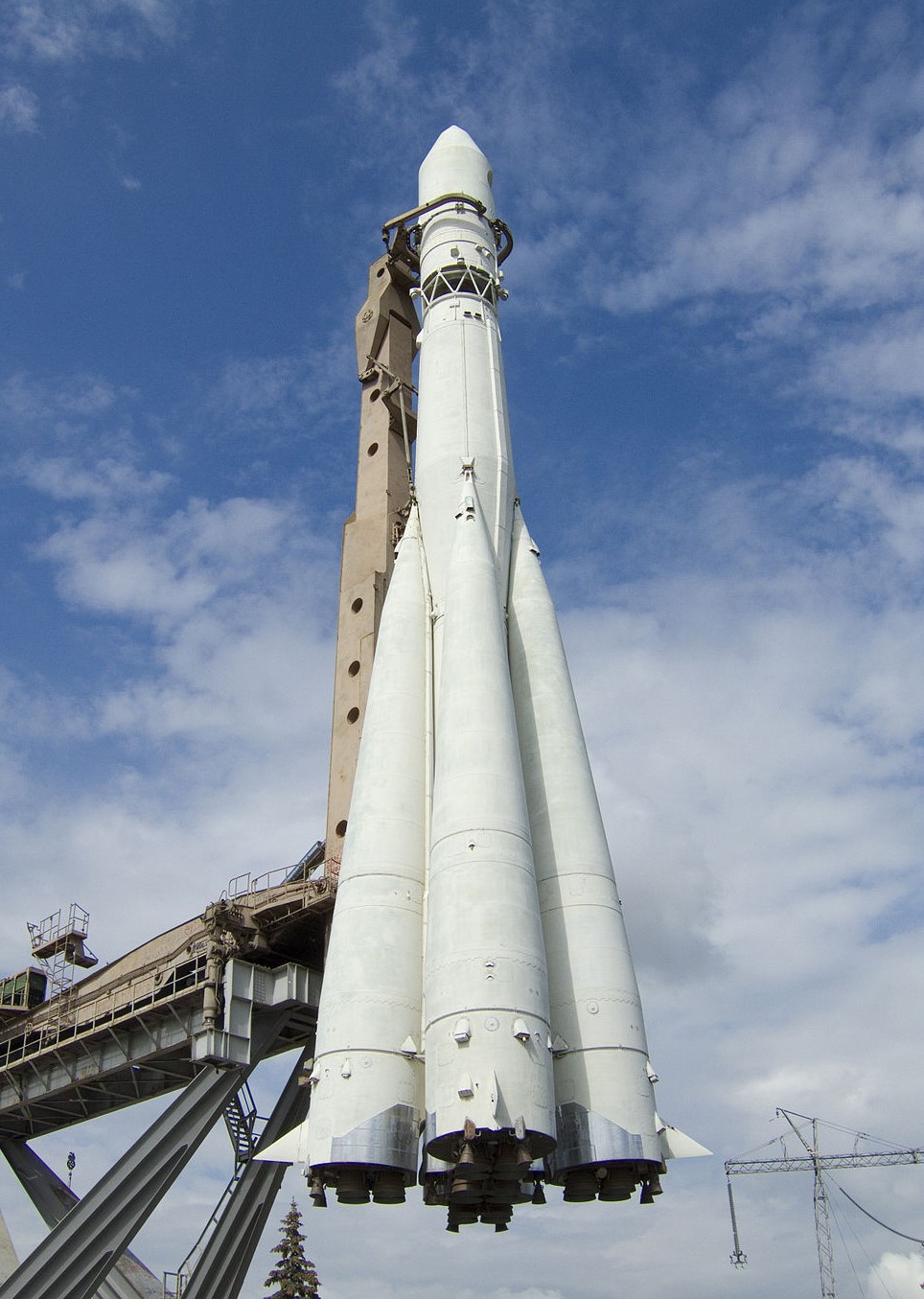
Vostok
In-activeSoviet Space Program (CCCP)
May 15, 1960
Description
The Vostok-K was an expendable carrier rocket used by the Soviet Union for thirteen launches between 1960 and 1964, six of which were manned. The Vostok-K made its maiden flight on 22 December 1960, three weeks after the retirement of the Vostok-L. The third stage engine failed 425 seconds after launch, and the payload, a Korabl-Sputnik spacecraft, failed to reach orbit. The spacecraft was recovered after landing, and the two dogs aboard the spacecraft survived the flight. On 12 April 1961, a Vostok-K rocket was used to launch Vostok 1, the first manned spaceflight, which made Yuri Gagarin the first human to fly in space.
Specifications
-
Stages
3 -
Length
30.84 m -
Diameter
2.99 m -
Fairing Diameter
― -
Launch Mass
280.0 T -
Thrust
971.0 kN
Family
-
Name
Vostok -
Family
― -
Variant
K -
Alias
― -
Full Name
Vostok-K
Payload Capacity
-
Launch Cost
― -
Low Earth Orbit
4725.0 kg -
Geostationary Transfer
Orbit
― -
Direct Geostationary
― -
Sun-Synchronous Capacity
―
Soviet Space Program
Government
None
CCCP 1931The Soviet space program, was the national space program of the Union of Soviet Socialist Republics (USSR) actived from 1930s until disintegration of the Soviet Union in 1991. The Soviet Union's space program was mainly based on the cosmonautic exploration of space and the development of the expandable launch vehicles, which had been split between many design bureaus competing against each other. Over its 60-years of history, the Russian program was responsible for a number of pioneering feats and accomplishments in the human space flight, including the first intercontinental ballistic missile (R-7), first satellite (Sputnik 1), first animal in Earth orbit (the dog Laika on Sputnik 2), first human in space and Earth orbit (cosmonaut Yuri Gagarin on Vostok 1), first woman in space and Earth orbit (cosmonaut Valentina Tereshkova on Vostok 6), first spacewalk (cosmonaut Alexei Leonov on Voskhod 2), first Moon impact (Luna 2), first image of the far side of the Moon (Luna 3) and unmanned lunar soft landing (Luna 9), first space rover (Lunokhod 1), first sample of lunar soil automatically extracted and brought to Earth (Luna 16), and first space station (Salyut 1). Further notable records included the first interplanetary probes: Venera 1 and Mars 1 to fly by Venus and Mars, respectively, Venera 3 and Mars 2 to impact the respective planet surface, and Venera 7 and Mars 3 to make soft landings on these planets.
Flight Record
No spaceflights found for .
Falcon 9
Starlink Group 17-35
Space Launch Complex 4E - Vandenberg SFB, CA, USAA batch of 25 satellites for the Starlink mega-constellation - SpaceX's project for space-based Internet communication system.
Falcon 9
Starlink Group 10-58
Space Launch Complex 40 - Cape Canaveral SFS, FL, USAA batch of 29 satellites for the Starlink mega-constellation - SpaceX's project for space-based Internet communication system.
Soyuz-5
Demo Flight
45/1 - Baikonur Cosmodrome, Republic of KazakhstanDemonstration Flight for Russia's new Soyuz-5 launch vehicle, with a mass simulator on board. Details TBD.
Space Launch System (SLS)
Artemis II
Launch Complex 39B - Kennedy Space Center, FL, USAArtemis II is the first crewed mission as part of the Artemis program. Artemis II will send a crew of 4 - 3 Americans and 1 Canadian around the moon …
Soyuz 2.1a/Fregat-M
Meridian-M No.21L
43/3 (43L) - Plesetsk Cosmodrome, Russian FederationNote: Payload identity uncertain. Meridian is a series of communications satellite for military and civilian use.